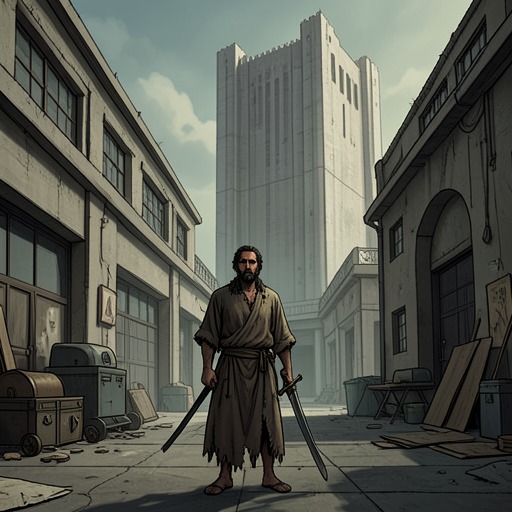
Ma Teng
The Romance of the Three KingdomsMa Teng is a tribal leader from the remote western regions whose opposition to Cao Cao links the failed conspiracy against Cao Cao to the later western campaign led by Ma Chao. He first urges the conspirators to seek help from Xuande, then accepts a dangerous summons to the capital in the hope of striking at Cao Cao himself. His capture and execution destroy that attempt, but they also give Ma Chao a direct motive for revenge and become part of a wider strategic struggle over whether Cao Cao can turn south.
Identity and Political Position
Ma Teng is presented as a powerful leader from the western regions, with tribal forces whose possible intervention worries Cao Cao. His importance is not limited to the plot against Cao Cao: while Xuande’s allies plan a joint attack on the north, Cao Cao fears that Ma Teng could exploit the absence of troops by attacking from the west. Cao Cao therefore considers drawing him to the capital with an official title and a request for military assistance, intending to eliminate the threat once Ma Teng has come within reach.
Ma Teng’s political position is precarious. Refusing an imperial summons could be treated as treason because Cao Cao controls the emperor, yet obeying it exposes him to the very power he hopes to challenge. This conflict shapes his decision: he does not mistake the invitation for a guarantee of safety, but weighs the danger of refusal against the chance to pursue his longstanding opposition to Cao Cao.
The Earlier Conspiracy and Xuande
When the conspirators are considering whom to approach for support, Ma Teng recommends Xuande, to the surprise of the others. Dong Cheng objects that Xuande is both related to the imperial family and a close ally of Cao Cao, and doubts that he will risk joining them. Ma Teng counters with his reading of the earlier hunt: Guan Yu would have killed Cao Cao, he says, had Xuande not intervened because their side was outnumbered. Ma Teng interprets that intervention as a tactical response to the circumstances, not proof that Xuande would never act against Cao Cao. Given a real chance of success, he believes Xuande will join the effort.
That original conspiracy fails, leaving Ma Teng and Xuande as the surviving members of the rebel group. Cao Cao decides that Xuande, whose army poses the greater immediate problem, must be attacked; a force of two hundred thousand is sent to capture Xuzhou and Xuande. The episode establishes the contrast between the conspirators’ clandestine plans and the open military power Cao Cao can bring to bear. Ma Teng remains a potential opponent, but Xuande becomes the immediate target.
Summons to the Capital and Betrayal
Later, Cao Cao seeks to neutralize the western danger by inviting Ma Teng to the capital under the appearance of offering him a title and asking for help against the south. Ma Teng recognizes that the invitation may be a trap. He takes his eldest son, Ma Chao, aside, places him in charge of their home base, and tells him of the earlier secret-message-in-the-belt conspiracy against Cao Cao. Ma Teng asks what he should do now that the summons has come. Ma Chao advises him to go: because Cao Cao controls the emperor, refusal could bring an accusation of treason, while the journey might offer an opportunity to accomplish Ma Teng’s longstanding aim of removing Cao Cao.
Ma Teng goes, but he brings five thousand tribal warriors as protection. Cao Cao assigns Huang Kui to oversee his arrival and make him comfortable, while directing Huang Kui to reduce Ma Teng’s own force on the pretext that Cao Cao will provide replacement soldiers and that food is scarce. The hospitality is thus paired with an attempt to limit the protection Ma Teng has brought with him.
After drinking with Ma Teng, Huang Kui reveals his hostility toward Cao Cao, whom he believes has usurped the emperor’s authority. At first Ma Teng remains guarded and does not admit that he shares this hatred. Huang Kui then refers to the earlier conspiracy involving the message hidden in the belt, convincing Ma Teng that the official is speaking sincerely. The two agree to lure Cao Cao outside the city to inspect the troops, where Ma Teng will kill him. Their plan depends on turning the military review into an opportunity for an attack.
The plot is exposed through a chain of personal betrayal. Disturbed after returning home, Huang Kui confides in his concubine, Li Chunxiang, rather than his wife. Li Chunxiang is having an affair with her brother-in-law, Miao Ze, who wants to marry her. She tells him about the assassination scheme; Miao Ze sees it as a way to remove Huang Kui and obtain Li Chunxiang, and reports the plan to Cao Cao. Cao Cao then prepares a counterplot. The conspiracy is undone not by Ma Teng’s misreading of Huang Kui, but by the private relationship and self-interest through which its secret escapes.
Capture, Execution, and Aftermath
The next morning Ma Teng, his sons, and their troops parade before the city walls. They see a group of banners emerging from the gate and charge, believing Cao Cao is there. The banners part to reveal archers and crossbowmen, while Cao Cao’s forces attack from several directions. One of Ma Teng’s sons dies defending him; Ma Teng and his other son are seriously wounded and captured. They are brought, with Huang Kui, before Cao Cao.
Ma Teng and his son are condemned and executed. The attempted assassination therefore ends in the deaths of its central participants, while the revelation of Miao Ze’s motive leads to a further reversal: having reported the plot, he asks Cao Cao for permission to marry Li Chunxiang and says he wants no other reward. Cao Cao rejects the request and orders Miao Ze, Li Chunxiang, Huang Kui, and Huang Kui’s entire family executed publicly. The episode presents betrayal as a chain whose participants cannot control the consequences once the conspiracy is exposed.
Ma Teng’s death does not end the military danger Cao Cao feared. When news reaches Ma Chao that his father and brothers have died, he vows revenge. Xuande’s message arrives at that moment proposing coordinated action: Ma Chao will attack from the west while Xuande attacks from the south. Ma Chao agrees, gathers support from leaders in the region, and advances toward Chang’an with more than two hundred thousand tribal warriors. His opening engagement defeats the governor Zhong Yao, who retreats into the city, and Ma Chao begins a siege. Thus the summons that was meant to draw Ma Teng into Cao Cao’s power produces, through his execution, the very western challenge Cao Cao had sought to prevent.
Narrative Role
Ma Teng’s arc turns on a repeated choice between submission to a power that controls the emperor and resistance to that power at the risk of being branded a traitor. His caution is real: he suspects the invitation is a trap, brings five thousand warriors, and initially withholds his views from Huang Kui. Yet the chance to renew his effort against Cao Cao ultimately outweighs that caution. His defeat is consequently both the end of his own conspiracy and the cause of Ma Chao’s next campaign.
The sequence also shifts the balance of the plot through political geography. Cao Cao’s concern about an attack from the west shapes his plans even while Xuande and his allies prepare for a southern campaign. Once Ma Teng is killed, the western threat becomes active rather than hypothetical; Xuande can enlist Ma Chao’s revenge as part of a coordinated strategy that prevents Cao Cao from concentrating on the south. Ma Teng is therefore a connecting figure between conspiracy, dynastic coercion, family succession, and military alliance: his failed attempt to reach Cao Cao helps set in motion the campaign that threatens Cao Cao’s capital from the west.